Rotten Tomatoes
Suggestions will appear as you start typing. Submit search Movies Tv shows RT App New News Showtimes

Rashomon

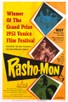
Play trailer Poster for Rashomon 1950,  1h 28m,  Drama Play Trailer Watchlist
Watchlist 98% 61 Reviews Tomatometer 93% 25,000+ Ratings Popcornmeter
98% Tomatometer 61 Reviews 93% Popcornmeter 25,000+ Ratings
Brimming with action while incisively examining the nature of truth, "Rashomon" is perhaps the finest film ever to investigate the philosophy of justice. Through an ingenious use of camera and flashbacks, Kurosawa reveals the complexities of human nature as four people recount different versions of the story of a man's murder and the rape of his wife.
Rashomon

What to Know

Critics Consensus

One of legendary director Akira Kurosawa's most acclaimed films, Rashomon features an innovative narrative structure, brilliant acting, and a thoughtful exploration of reality versus perception.

Read Critics Reviews

Critics Reviews

View More
Adam Kempenaar Filmspotting Jun 12, 2026
5/5
...the version of [each] story that's being told is still being filtered through the woodcutter and the priest... It's their version of what they saw or heard. Go to Full Review
Kevin Maher The Times (UK) Jan 9, 2023
5/5
It’s easy to forget, nonetheless, that the movie offers more rewards than a dazzling superstructure. It’s beautifully shot, vividly performed and is ultimately an arresting pop treatise on the impossibility of objective truth. Go to Full Review
Peter Bradshaw Guardian Jun 17, 2010
5/5
Unmissable. Go to Full Review
Matt Brunson Film Frenzy Jul 5, 2026
4/4
In many ways as groundbreaking and daring as Citizen Kane in its thematic content and technical achievements. Go to Full Review
Michael Clark Epoch Times Sep 21, 2024
5/5
“Rashomon” isn’t a whodunit thriller. Instead, it’s an observation of the unreliability of human short-term memory, particularly of the multiple witnesses at a crime scene, who are also possible victims or perpetrators. Go to Full Review
Mike Massie Gone With The Twins Jul 20, 2024
6/10
Thoroughly unique, crafting a recognizable template for future films that opt to distort their narratives through the eyes of multiple storytellers and unreliable presentations of facts. Go to Full Review
Read all reviews

Audience Reviews

View More
Mar 26, 2019 Very impressive. Rashomon can make us think deeper into human nature. Just like it suggested in the movie, everyone is dishonest and selfish. They will hide the truth for keeping their dignity(like the pirate in the movie), their virginity(like the woman in the movie)... The same story, different people have a different statement for their own interests. This is very interesting, in reality, this kind of situation is really common, maybe we all just tend to ignore it. See more
Harry S Mar 3, 2019 It's RIDICULOUS that this is 50th in all time list of best movies. MOST great film directors learn and take from Kurosawa's movies like this one, AND i's nowhere near his best like 7 Samurai and Ikiru. Rotten Tomatoes shows it's becoming more of a SELLOUT site for GARBAGE new movies versus REAL skills like the movie Rashomon on all sides from acting, directing, and cinematography See more
Rey L Feb 9, 2019 The director seems to be saying that everyone is a cowardly hypocrite and the only way to change that is to do the little part that you can to change the world, but it ends up being very convoluted getting to that point. The notion of subjective truth that I read in the reviews about this film weren't very accurate, as the character's lying to themselves doesn't change the fact that they still know what happened and the kind of worthless human that they are. No amount of testifying to others some cock and bull story will change the story from what actually happened. It's true that in time it would be possible for them to alter their own memories by lying to themselves, but this doesn't back the idea of subjective truth as a viable process and theory. The scene where the lady had the knife was incredibly cheesy, as she went forwards, backwards, left and right over and over again with the fakest expression of terror on her face she probably could muster. Mifune isn't as good as I saw him in Seven Samurai, but he isn't awful. A lot of the shots are beautiful, and lot of the scenes are stale. This is such a mixed bag, I have no idea why it is so highly regarded. See more
Ron S Dec 25, 2018 I can't say I enjoyed the film, nevertheless I appreciate the interpretation the director gave to the story, and how revolutionary and innovative it was at its time See more
Han M Dec 2, 2018 My favorite Akira Kurosawa film, and maybe my favorite film. I love everything about it. The characters, The story, and the message give us a masterpiece. See more
Anakin R Nov 13, 2018 A landmark film with endless interpretations and analyses, so Iâ(TM)ll try my best not to prattle on. There is a good dose of cynicism in Rashomon, with human nature shown to be selfish and for people to lie, or perhaps more delicately, to distort the truth through the lens of their own perception. A couple of serious crimes have been committed in the forest, and whatâ(TM)s happened is told from four different perspectives. Common to all is that a samurai and his wife were travelling through the woods, and then set upon by a bandit (the incomparable Toshiro Mifune). He ties up the samurai and rapes his wife in front of him, and afterwards the samurai is found dead. Itâ(TM)s a grim, awful crime, and worse yet, because of the culture and the period, the rape is viewed with elements of dishonor and shame in the woman. Beyond that, the truth is elusive, and once we see that the flashbacks vary in their accounting, we realize it may be difficult to arrive at what actually happened. In the banditâ(TM)s account, he puts himself in the best possible light. The woman fights courageously with a dagger before succumbing to him, but then grasps him in her arms when he assaults her, indicating consent in the end. She then tells the bandit that because of the shame, either he or her husband must die, urging them to fight to the death, which they do valorously. The lens here is clearly the banditâ(TM)s masculinity, perhaps what is most important to him. In the womanâ(TM)s account, after sheâ(TM)s raped and the bandit leaves, all she can see are her husbandâ(TM)s eyes, boring in to her own. She feels guilty, horribly guilty, and faints near him with the dagger in her hand. When she comes to, her husband is dead, and she attempts suicide multiple times but fails. In her case, the lens is one emphasizing her feeling of shame, as painful as that is for us to see. In the samuraiâ(TM)s account, cleverly told through a medium, after the rape, his wife is about to leave with the bandit, when she asks him to kill her husband. The bandit is shocked by the request, and asks the samurai if he wants to kill the woman, or let her go. Because of that honorable action, heâ(TM)s willing to pardon the bandit. The woman flees, and after the bandit releases the samurai, the samurai commits suicide. In this case, the lens emphasizes an honor code, and puts more control of what must have been a helpless and humiliating situation back in the hands of the samurai. This is where the 1922 short story â~In a Groveâ(TM) from Ryunosuke Akutagawa ends, and I find it fascinating that Kurosawa added the woodcutterâ(TM)s account (beyond him simply finding the body). In this version, after the rape, the bandit begs the woman to marry him, but she refuses and releases the samurai. Instead of an epic battle for her hand, the two are both cowardly, only fighting when she spurs them on, and then with more fear than skill. Itâ(TM)s very tempting to think that this must represent the closest thing to truth, as itâ(TM)s told from an outside observerâ(TM)s perspective, contains elements of the otherâ(TM)s stories, and shows no one in a flattering light. However even it has discrepancies, casting doubt over it, and thus, the truth is ever elusive. If you think about it, each of the first three stories has an underlying misogyny. In the first, the woman says no, but given enough force, eventually says yes. In the second, she essentially feels guilty for having been raped. In the third, while the samurai and even the bandit display honor, her shame is so great that she requests her husband be murdered. Perhaps there is some redemption in the woodcutterâ(TM)s story when she criticizes her husband for not protecting her in the first place. The other aspects that Kurosawa added relative to the original story was the setting at â~Rashomonâ(TM), which was the largest gate in Kyoto, the discussion at the gate throughout the narrative, and the ending sequence with the baby. Akutagawa had also written a short story called â~Rashomonâ(TM), which is published today along with â~In a Groveâ(TM) and others in a slim volume, and Kurosawa took this setting and the title from the other story. The gate had fallen into disrepair and was a hide-out for thieves as well as a place to abandon bodies, and as the rain pours down, we feel the wretchedness of the human condition. In providing the ending sequence though, Kurosawa seems to give us an answer to the central question posed by the film: how can anything be accomplished when eyewitnesses canâ(TM)t even agree on the simple truth of past events, and people are so selfish, driven by their own egos? Itâ(TM)s through mercy and kindness, acts which transcend misunderstanding. See more
Read all reviews
Rashomon

My Rating

Read More Read Less WRITE A REVIEW EDIT REVIEW POST RATING
The Wages of Fear 100% 95% The Wages of Fear Watchlist The Killing 96% 92% The Killing Watchlist Z 94% 92% Z Watchlist The Discreet Charm of the Bourgeoisie 98% 88% The Discreet Charm of the Bourgeoisie Watchlist The Young and the Damned 91% 95% The Young and the Damned Watchlist Discover more movies and TV shows. View More

Movie Info

Synopsis Brimming with action while incisively examining the nature of truth, "Rashomon" is perhaps the finest film ever to investigate the philosophy of justice. Through an ingenious use of camera and flashbacks, Kurosawa reveals the complexities of human nature as four people recount different versions of the story of a man's murder and the rape of his wife.
Director
Akira Kurosawa
Producer
Minoru Jingo
Screenwriter
Ryûnosuke Akutagawa, Shinobu Hashimoto, Akira Kurosawa
Distributor
RKO Radio Pictures
Production Co
Daiei Motion Picture Company
Genre
Drama
Original Language
Japanese
Release Date (Theaters)
Dec 26, 1950, Wide
Release Date (Streaming)
Mar 23, 2017
Runtime
1h 28m
Sound Mix
Mono
Aspect Ratio
Academy (1.33:1)
Join The Newsletter Join The Newsletter Cookie Settings